 |
|
 |
|
 |
 |
 |
 |
 |
 |
|||||||
|
|
|
|
|
|
|
|
|
|
|
|
|
 |
||
|
|
|
Alaska Cruising 101 |
||
|
|
|
Headed “Up North?” Taking an Alaska cruise is probably one of the best travel values you’ll ever find. Here are some things to consider. First come itineraries; there are several choices: Seattle to Seattle round trip: Generally the most affordable cruises, these typically make two or three port calls, plus part of a day at either Glacier Bay, Hubbard Glacier, or Tracy Arm. While these are often billed as ‘Inside Passage’ cruises, their route usually is up the west or outside coast of Vancouver Island rather than the scenic traditional Inside Passage through the narrower channels east of Vancouver Island. Vancouver to Vancouver round trip: Like Seattle sailings, these offer usually three ports and glacier viewing. Modestly priced in that you didn’t have to fly back from Alaska as you would with a one way cruise, and also offering the advantage of traveling both northbound and southbound up the traditional and very scenic Inside Passage, east of Vancouver Island Vancouver to Seward or Whittier: One way cruises either to or from Alaska, offering an additional part of a day of glacier viewing, usually at College Fjord in Prince William Sound. A particular advantage of these cruises are that they afford you an opportunity to explore interior as well as coastal Alaska. The most popular add-on itinerary is to spend a day or two in both Fairbanks and Anchorage, take one of the wonderful vistadome style railroad cars on the Alaska Railroad between those towns, combined with a one or two day stopover in the Denali or McKinley National Park area. Many families will start with a Seattle or Vancouver round trip cruise, and then follow up in later years with a one way cruise combined with a week or so exploring Alaska’s great interior. Other itineraries: San Francisco - Alaska round trip, usually works out to a 10 day cruise, with two sea days on either end, usually includes Victoria and a second day of glacier watching. Which ship? There’s a lot of choice here; presently some 25 large and a dozen or so smaller ships operate on the Alaska run. Today’s big Alaska cruise ships are essentially floating resorts with multiple restaurants, extensive shopping, elegant theatres, a wide variety of art, and many public spaces. Free dining (most drinks extra) is usually offered in the large formal dining rooms as well as in a large buffet area on the upper decks. The most recent trend is to charge a fee in the smaller, themed, restaurants, typically $15 - $20 a person, a modest price for the excellent food and service you will usually receive. Take some time to check out the restaurant choices aboard your ship. Some ships, like the Coral, Sun, and Dawn Princess create a white tablecloth steakhouse in part of the Horizon Court area near the bow. With a stunning view out to the passing landscape, it is a memorable eating experience. A very valuable feature for ships operating in Alaska is an eating or viewing area that stretches the full width of the front of the ship on an upper deck. You may find eating buffet style with a 180 degree view preferable to the traditional dining rooms, with full service and presentation, but usually little view. |
 |
|||||||||
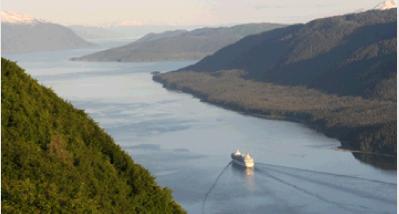
Stay up late and get up early up here.. there's lots of daylight and lots to see!! |
||||||||||
 |
||||||||||
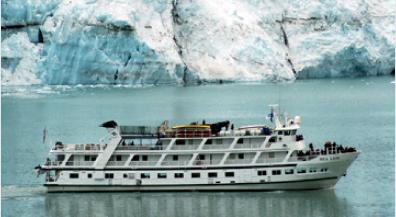
Small ship cruises are a more intimate but more expensive alternative to big ship cruises |
||||||||||
Alaska Cruise Tips It’s only formal if you want it to be. Don’t feel like you have to bring suits and dresses unless that is your style. Alaska is a very casual place, and on board your ship there are always other places to eat than the main dining room on formal night. Bring binoculars. Generally on board ship, anything over 10 power might not be a good choice because of the ship’s motion. If you didn’t bring any, consider buying them on board. Always bring them when you leave the cabin. Bring fleece and raingear. Southeast Alaska is a rainy place, but generally the rain is of the light misting variety. So if you have a good rain jacket, you won’t be bothered too much. Don’t worry about rainpants unless you’re determined to hike, rain or not. Make sure you have at least one good warm fleece that you can layer under a jacket. Especially on glacier day, it can get mighty chilly on deck. Explore your ship early. These big ships have a lot of nifty little places to hang out and watch the passing scene. Don’t discover them on the last day. Eat where there’s a view. I can’t emphasize this enough, especially on ships that have a forward eating area on an upper deck. You don’t have to eat in the formal dining room. Especially on your first night out, you’ll be missing some truly spectacular scenery if you don’t Always look for whales. Although most ships have naturalists with a beeper who can be called to the bridge if there is a whale sighting, there are a lot of competing activities on board, and the whales may or may not be announced. Know what to look for: a puff of what looks like smoke, easily seen from a distance. It is a whale exhaling. If you know what to look for, you’ll see a lot more whales. |
||||||||||
|
|
|
|
|
|
|
|
|
|
|